1. Start with the letter, not the module
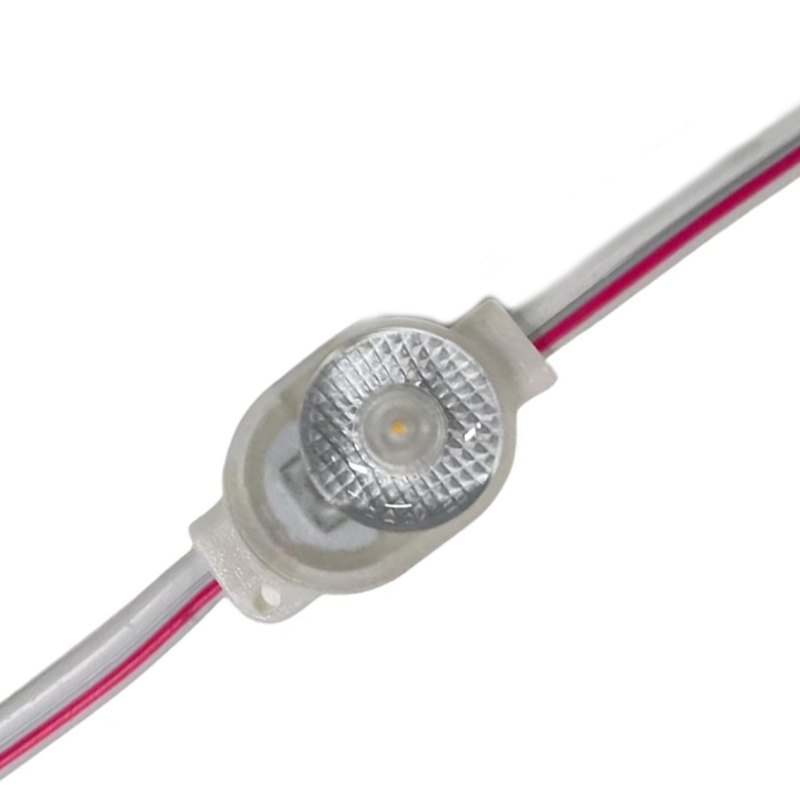
Depth drives everything. A 7 cm storefront letter needs a compact 1.5W module; a 20 cm pylon letter needs high-power 3030s with wider pitch. Measure depth and face material first — then pick modules to hit target lux, usually 1500–2500 lux on the face for retail readability.
2. Do the brightness math
Lumen claims mean nothing without beam angle and spacing. A 2W module at 160° spreads light wide; at 12 cm pitch, effective illumination stacks predictably. Ask suppliers for lux at distance, not lumens — a factory that can answer this in one reply knows its own product.
3. Watch for inflated lumen specs
The market's dirty secret: many "300 lumen" modules are re-labeled 120 lumen chips. Two defenses: request a datasheet with test conditions (lm/W at what current), and order samples — measure with a lux meter before the big order. Any serious factory provides both without complaint.
4. IP ratings — what they actually guarantee
IP65 survives splashing rain; IP66 handles heavy jets; IP68 survives continuous immersion. For most channel letter work, IP66+ is the practical outdoor floor. But sealing quality varies more than ratings do — ask how the potting is applied (full-pot vs bead), and whether units are immersion-tested per batch.
5. The real cost per letter
Compare systems, not modules: module price × count + driver cost + wiring + labor + expected failure cost. A cheap module that dies in year two costs a lift rental to replace. This is why verified aging test data matters more than a 3% unit-price difference.
6. Voltage system: DC or AC direct?
DC12V systems are universal and safe to service, but need drivers sized at 80% load. AC220V direct modules eliminate drivers entirely — attractive on 220V grid markets ( Middle East, Southeast Asia, Latin America, Africa) for large letters and light boxes. Match the system to your local grid and service capability.
7. Sample → pilot → scale
Order 20–50 pcs, build one letter, measure lux and color consistency. Then pilot one full sign before committing the year's volume. Factories confident in their product support this workflow — ours builds it into every first order.